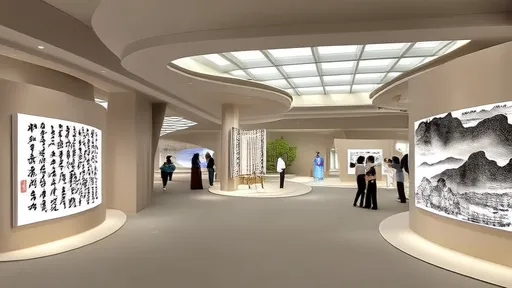
Under the golden chandeliers of the Macao Museum of Art, a quiet revolution is taking place in the way Chinese regional culture is presented on the international stage. The Macao International Art Biennale 2023 has dedicated an entire pavilion to Jinan, a city historically overshadowed by its more famous neighbors like Beijing and Shanghai. This is not merely a regional showcase; it is a profound statement about the evolving narrative of Chinese cultural identity.
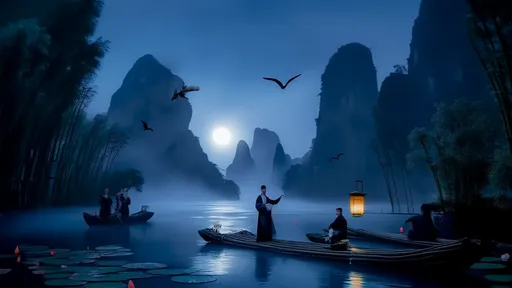
The exhibition, titled Whispers of the Yellow River, Echoes of the Spring City, immediately establishes its dual thematic core. The first gallery is dominated by a monumental, floor-to-ceiling video installation by contemporary artist Liang Shaoji. Titled "The River's Pulse," it does not feature sweeping, postcard-perfect shots of the Yellow River. Instead, it uses submerged micro-cameras to capture the turbulent, sediment-rich flow at a molecular level. The effect is visceral and overwhelming; the gallery is filled with the sound of churning water and the visual of a relentless, earthy torrent. It is a raw, unfiltered representation of the river not as a scenic landmark, but as the lifeblood and temperamental soul of northern China. This is the Yellow River as a living, breathing, and sometimes terrifying force of nature.
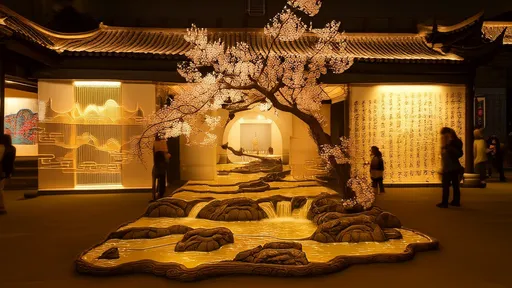
Adjacent to this powerful display, the mood shifts dramatically. The second section, "The Spring City's Breath," is an oasis of tranquility. Here, artist Wang Luyan presents "One Hundred and Eight Drums," an intricate kinetic sculpture. One hundred and eight porcelain bowls, reminiscent of those used to collect spring water in Jinan's famous Baotu Spring, are arranged in a grid. Using a complex system of magnets and pulleys, droplets of water fall from a hidden source into each bowl at meticulously timed intervals. The resulting sound is not a chaotic splash, but a gentle, rhythmic percussion—a symphony composed by the springs themselves. This piece masterfully translates the city's most defining natural feature into an immersive auditory and visual experience, embodying the refined, contemplative spirit of Jinan's spring culture.
This interplay between the monumental and the minute, the powerful and the peaceful, forms the intellectual backbone of the entire pavilion. Curator Dr. Evelyn Wong, in an interview, elaborated on this curatorial vision. "We wanted to move beyond the clichés," she stated, her gaze fixed on Liang Shaoji's roaring river. "The Yellow River is often depicted for its scale and its historical significance as the 'Mother River.' But we asked, what is its texture? What is its sound from within? Similarly, Jinan's springs are not just tourist attractions; they are the very rhythm of the city's daily life. By focusing on these sensory and elemental qualities, we are attempting to articulate a more nuanced, more authentic cultural vocabulary."
The exhibition continues to explore this vocabulary through a diverse range of media. A series of large-format photographs by documentarian Li Mei captures the intimate relationship between Jinan's elderly residents and the city's water. One striking image shows an old man washing his vegetables in a public spring, the water crystal clear against the vibrant green of the vegetables. Another shows children skipping stones on a placid section of the Yellow River at dusk. These are not grand historical narratives but quiet, human-scale stories that speak volumes about a culture shaped by its hydrological environment.
Perhaps the most talked-about piece is a mixed-media installation by the young, avant-garde collective "Pixel Soup." Titled "Data Stream: From Lashihai to Bohai," the work uses real-time data feeds from hydrological stations along the Yellow River. The data—water flow, sediment concentration, pH levels—is algorithmically converted into a mesmerizing, ever-changing pattern of light and sound projected onto a massive, curved screen. A companion augmented reality app allows visitors to point their devices at the projection to see virtual artifacts—an ancient pottery shard, a forgotten folk song lyric—emerge from the data streams, symbolizing the cultural sediment carried by the river through time. This piece boldly bridges the ancient and the ultra-modern, suggesting that the river's story is still being written in binary code.
The inclusion of such contemporary, technology-driven work is a deliberate and significant aspect of the pavilion's identity. It firmly positions the cultural discourse around Jinan and the Yellow River within a 21st-century context. This is not a museum diorama of a frozen past; it is a dynamic dialogue between deep tradition and cutting-edge expression. The artists are not merely preserving culture; they are interrogating it, re-contextualizing it, and allowing it to evolve in real-time before the viewer's eyes.
The critical and public reception has been notably positive. International art critic Benjamin Croft, writing for The Art Newspaper, noted, "The Jinan Pavilion is a revelation. It sidesteps the grandiose, state-sponsored aesthetic that often characterizes Chinese cultural exports and instead delivers something far more personal, sensory, and intellectually robust. It demonstrates a new confidence in Chinese regional art—the confidence to be subtle, to be complex, and to trust the audience to engage with that complexity."
For the city of Jinan, this presentation at a prestigious international forum like the Macao Biennale represents a strategic and cultural milestone. It is a powerful assertion of a unique urban identity that is both grounded in its ancient geographical blessings and actively engaging with the global contemporary art scene. The success of this pavilion suggests a new model for Chinese cities to articulate their cultural narratives—not through bombastic displays of historical might, but through thoughtful, artist-led explorations of their fundamental essence.
As visitors exit the pavilion, they pass by a final, simple installation: a single, continuous stream of water falling into a black pool, creating concentric, expanding ripples. It is a quiet, meditative end to a powerful sensory journey. This Jinan chapter at the Macao Biennale does indeed feel like a carefully dropped stone, its cultural and artistic ripples destined to travel far beyond the confines of the gallery, challenging and enriching the world's understanding of this ancient yet vibrantly modern Chinese city.
By /Oct 24, 2025
By /Oct 24, 2025
By /Oct 24, 2025
By /Oct 24, 2025
By /Oct 24, 2025
By /Oct 24, 2025
By /Oct 24, 2025
By /Oct 24, 2025
By /Oct 24, 2025
By /Oct 24, 2025
By /Oct 24, 2025
By /Oct 24, 2025
By /Oct 24, 2025
By /Oct 24, 2025
By /Oct 24, 2025
By /Oct 24, 2025
By /Oct 24, 2025
By /Oct 24, 2025
By /Oct 24, 2025
By /Oct 24, 2025