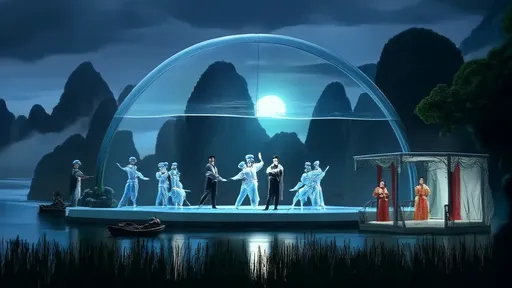
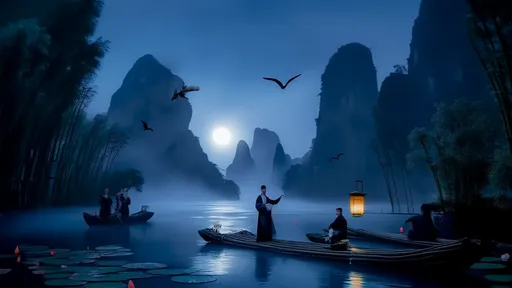
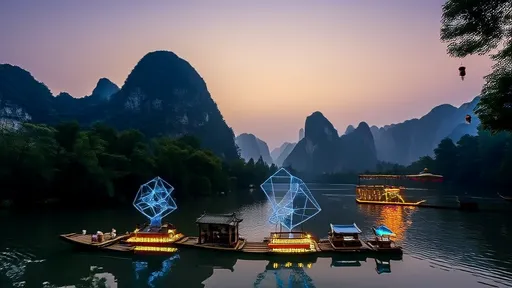
As the morning mist lifts from the karst peaks of Guilin, a new artistic dawn breaks over the Li River. The inaugural Guilin Art Festival has unveiled its theatrical program, presenting two extraordinary productions that merge world literature with China's most breathtaking natural scenery. In a bold curatorial move, the festival organizers have staged two seemingly disparate works—Jules Verne's visionary sci-fi adventure 20,000 Leagues Under the Sea and Anton Chekhov's timeless masterpiece The Seagull—within the same natural amphitheaters, creating what critics are already calling "the most innovative theatrical experience in recent memory."
The concept itself appears almost as fantastical as Verne's imagination: classic works of Western literature performed not in traditional theaters but within the living landscape of Guilin's iconic mountains and rivers. Audiences don't simply watch these performances; they journey through them, moving between performance sites as the stories unfold around them. The productions utilize the natural topography as both stage and character, with limestone formations becoming the Nautilus's observation deck in one moment and Sorin's country estate the next.
Twenty Thousand Leagues in Reed Flute Cave
The Reed Flute Cave, a spectacular natural limestone cavern adorned with centuries-old inscriptions, provides the otherworldly setting for Verne's submarine epic. As audiences descend into the cave's mouth, they leave behind the terrestrial world and enter Captain Nemo's domain. The production transforms the cave's magnificent stalactites and stalagmites into the interior of the Nautilus, with clever lighting design making the crystalline formations appear to pulse with the submarine's mysterious energy source.
What makes this production particularly remarkable is how it reimagines Verne's technological marvel through organic means. Rather than attempting to recreate metallic submarines with props and sets, the directors have embraced the cave's natural architecture. The famous observation window scenes occur at the cave's natural openings, where audiences peer out into the underwater world—represented by projected images that merge with the actual landscape beyond. When the Nautilus encounters giant squids, dancers in elaborate costumes emerge from shadowy crevices, their tentacles seeming to grow directly from the cave walls themselves.
The sound design deserves special mention—the cave's natural acoustics amplify every whisper and echo, creating an immersive soundscape that makes audiences feel truly submerged. Water drips from stalactites become sonar pings, and the distant rumble of underground rivers transforms into the Nautilus's engines. During the famous attack sequence, percussionists hidden throughout the cave create thunderous rhythms that vibrate through the stone beneath spectators' feet.
The Seagull Takes Flight at Seven Star Park
Just a short walk from the submarine fantasies of Reed Flute Cave, Chekhov's characters navigate their tangled relationships amid the serene beauty of Seven Star Park. The production uses the park's natural features with brilliant subtlety—a tranquil pond becomes Sorin's estate lake, weeping willows form natural curtains between scenes, and ancient stone bridges serve as the perfect setting for Konstantin and Nina's fateful encounters.
Director Li Wei has made the bold choice to stage the production during the golden hours of dusk, allowing the fading light to mirror the characters' diminishing hopes. As Trigorin becomes increasingly obsessed with using Nina as literary material, the shadows lengthen across the lawn. When Arkadina delivers her famous line about the theater being a temple, she stands before the park's ancient Camel Hill, its silhouette resembling a natural cathedral against the twilight sky.
The environmental staging creates unexpected resonances with Chekhov's themes. The constant background chorus of crickets and frogs becomes a Greek chorus commenting on human folly. Real seagulls occasionally fly overhead during performances, creating moments of magical coincidence that blur the line between performance and reality. During Nina's final monologue about enduring hardship for art's sake, the moon rises precisely behind her, as if nature itself has joined the production team.
Artistic Vision and Cultural Dialogue
Festival artistic director Zhang Ming explains the conceptual framework behind this ambitious pairing: "Both works, despite their different genres and eras, explore humanity's relationship with environment—whether it's the hostile depths of the ocean or the suffocating comfort of a country estate. By placing them in dialogue within Guilin's landscape, we're creating a new conversation between Eastern and Western artistic traditions, between human creation and natural beauty."
The productions demonstrate a sophisticated understanding of environmental theater that goes beyond mere novelty. The directors have carefully considered how each location's specific qualities can enhance the thematic concerns of the texts. The Reed Flute Cave's mysterious depths perfectly complement Verne's themes of exploration and the unknown, while Seven Star Park's cultivated natural beauty mirrors Chekhov's examination of art and artifice.
International theater critics who attended preview performances have expressed astonishment at the productions' emotional impact. "I've seen The Seagull performed in every major capital from Moscow to New York," noted British critic Eleanor Vance, "but never have I felt so acutely the characters' connection to their environment. When Nina speaks of her struggles, you feel the weight of the mountains around her. It's transformative."
Technical Innovations and Challenges
Mounting such ambitious productions in natural environments presented significant technical challenges that required innovative solutions. The production teams developed specialized wireless audio systems that allow audiences to hear every word clearly despite the open-air settings. For the cave production, engineers created a sophisticated lighting system that operates on minimal power to preserve the delicate cave ecosystem.
Perhaps most impressively, both productions maintain complete environmental responsibility. All sets are temporary and removable, pathways are designed to prevent soil erosion, and audience numbers are carefully controlled to minimize ecological impact. The festival has partnered with environmental organizations to ensure that the natural venues remain pristine for future generations.
The productions also represent a triumph of logistical planning. Audience movement between sites is choreographed as carefully as the performances themselves, with guides leading groups along specially prepared paths that become part of the theatrical experience. The transition from the dark, enclosed cave to the open parkland is deliberately designed to enhance the emotional journey between the two very different works.
A New Model for Theater
The Guilin Art Festival's theatrical program represents more than just two successful productions—it suggests a new direction for theatrical performance in the 21st century. In an era of increasing digital immersion, these works demonstrate the unique power of live performance integrated with natural environments. They offer audiences an experience that cannot be replicated through screens or traditional venues.
The festival's success also highlights China's growing influence in global theater innovation. While Western countries continue to debate the future of live performance, Chinese artists are creating bold new forms that honor both international classics and local environmental heritage. The Guilin model—site-specific environmental theater using natural landscapes—may well become an exportable art form that positions China at the forefront of theatrical innovation.
As night falls over Guilin and the final performances conclude, audiences depart with more than just memories of two great plays. They carry with them the experience of art and nature in perfect harmony, of Western classics reimagined through Eastern landscape, of theater that doesn't simply occupy space but converses with it. The mountains and rivers of Guilin have hosted poets and painters for centuries—now they've welcomed a new generation of artists who understand that sometimes the most spectacular sets aren't built by human hands, but created by nature itself.
The Guilin Art Festival continues through the month, with organizers already planning expanded programming for next year. If these inaugural productions are any indication, this festival may well become one of Asia's most important cultural events, proving that when it comes to great theater, sometimes the best director is nature itself.
By /Oct 24, 2025
By /Oct 24, 2025
By /Oct 24, 2025
By /Oct 24, 2025
By /Oct 24, 2025
By /Oct 24, 2025
By /Oct 24, 2025
By /Oct 24, 2025
By /Oct 24, 2025
By /Oct 24, 2025
By /Oct 24, 2025
By /Oct 24, 2025
By /Oct 24, 2025
By /Oct 24, 2025
By /Oct 24, 2025
By /Oct 24, 2025
By /Oct 24, 2025
By /Oct 24, 2025
By /Oct 24, 2025
By /Oct 24, 2025