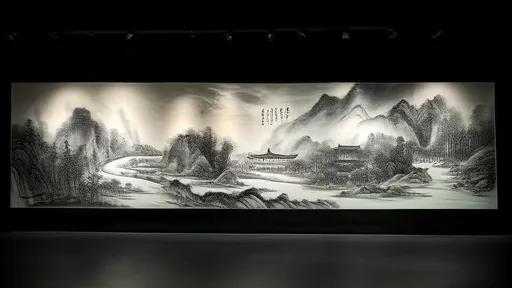
Against the backdrop of Macau's glittering skyline, a monumental work of Chinese ink art has become the undisputed centerpiece of the 2023 Macau Biennial, commanding attention from collectors, critics, and art enthusiasts alike. The 54.64-meter continuous scroll titled "The Great River Roars" represents not merely an artistic achievement but a profound cultural statement that bridges ancient tradition with contemporary vision.
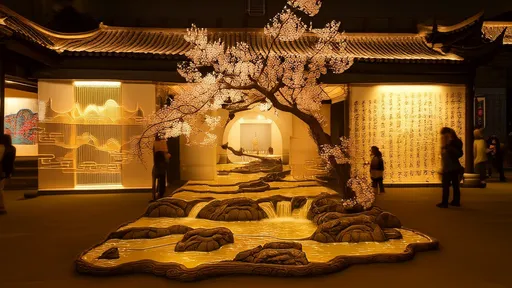
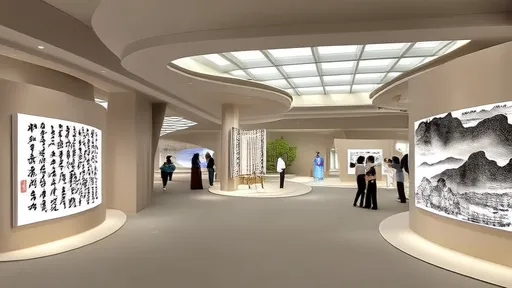
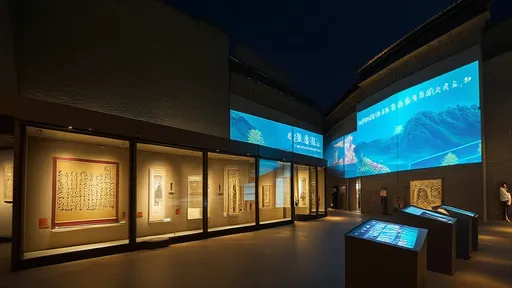
Stretching across an entire exhibition hall at the Macau Museum of Art, the scroll unfolds like the very river it depicts—beginning with tranquil mountain streams and building gradually to powerful, rushing currents. What makes this work particularly remarkable is its creation by a collective of sixteen ink artists from across China, who worked in seamless collaboration for over three years to achieve the scroll's astonishing coherence of vision and execution.
The technical mastery displayed throughout the scroll borders on miraculous. Traditional ink wash techniques merge with innovative approaches to create depth, movement, and emotional resonance that few single-artist works could achieve. The artists employed multiple layers of ink washes to build up textures that seem to shift and change as viewers move along the scroll's considerable length, creating an almost cinematic experience of following a river from its source to its dramatic convergence with the sea.
Professor Zhang Wei, the project's lead artist and conceptual director, explained during the opening ceremony that the river serves as both subject and metaphor. "We sought to capture not just the physical journey of water from mountain to ocean, but the cultural and historical currents that have flowed through Chinese civilization for millennia. The river represents continuity, power, adaptation, and ultimately—the relentless forward movement of life itself."
International curators attending the Biennial have expressed particular admiration for how the work engages with environmental themes without becoming didactic. The scroll subtly incorporates elements that speak to both the beauty and fragility of river ecosystems, with certain sections depicting the delicate balance between human civilization and natural forces. This environmental consciousness feels especially poignant given the increasing concerns about river conservation worldwide.
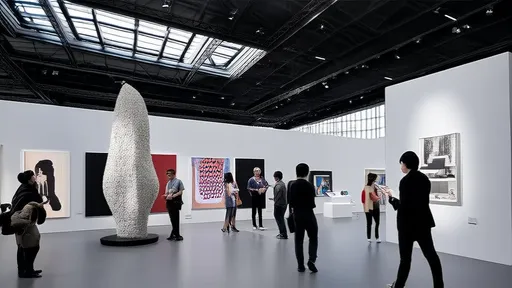
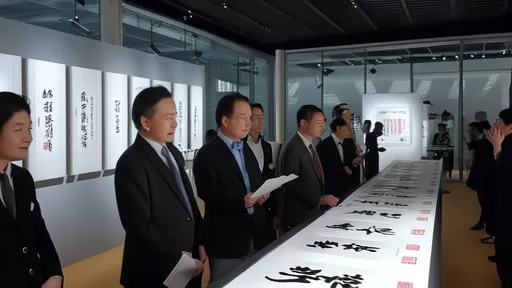
The physical presence of the scroll creates an immersive experience that has captivated visitors. Unlike traditional gallery displays where artworks remain static, "The Great River Roars" demands movement and time from its audience. Viewers find themselves walking alongside the unfolding narrative, discovering new details and perspectives with each step. This kinetic relationship between artwork and observer has become one of the most discussed aspects of the piece among Biennial attendees.
Critical reception has been overwhelmingly positive, with several prominent art publications dedicating extensive coverage to the scroll's debut. Art Asia Pacific described it as "a watershed moment for contemporary ink painting," while The International Herald Tribune's art critic noted that "the work successfully navigates the delicate balance between honoring tradition and pushing boundaries—much like the river it portrays navigates the landscape between mountain and sea."
Beyond its artistic merits, the scroll has sparked important conversations about cultural preservation and innovation. The artists deliberately incorporated techniques and motifs from various historical periods of Chinese painting, creating what amounts to a visual history of ink art within a single continuous narrative. This self-referential quality has made the work particularly valuable for academic study, with several universities already planning scholarly symposia dedicated to analyzing its numerous cultural and technical dimensions.
The timing of the scroll's unveiling carries additional significance, coinciding with renewed international interest in Chinese artistic traditions and their contemporary applications. As Western art markets increasingly look beyond conventional contemporary forms, works like "The Great River Roars" demonstrate the continued vitality and relevance of media that might otherwise be dismissed as traditional or historical.
Perhaps most impressively, the scroll manages to feel simultaneously ancient and utterly contemporary. The materials—xuan paper, ink sticks, and mineral pigments—remain true to centuries-old practices, while the scale, collaborative nature, and conceptual framework speak directly to current artistic concerns about community, environment, and global interconnectedness.
As the Biennial continues through its three-month run, museum officials report that visitor numbers have significantly exceeded projections, with many attendees specifically mentioning the ink scroll as their primary reason for visiting. The museum has extended viewing hours for the installation and implemented timed entry to manage crowds, while educational programs and guided tours focused on the work have been consistently fully booked.
The success of "The Great River Roars" at the Macau Biennial suggests a growing appetite for ambitious, large-scale works that demand both technical excellence and conceptual depth. In an art world often dominated by digital media and conceptual minimalism, the powerful physical presence and emotional resonance of this traditional-medium work has clearly struck a chord with international audiences.
Looking forward, negotiations are already underway for the scroll to travel to major museums in Europe and North America after the Biennial concludes. These international exhibitions would mark a significant moment for contemporary Chinese ink art, potentially introducing the form to new audiences and establishing its place within global contemporary art dialogues.
For now, the scroll continues to draw crowds in Macau, its flowing ink landscapes serving as a powerful reminder of art's capacity to capture both the timeless and the timely. As visitors walk its length, they participate in a journey that is at once geographical, historical, and profoundly artistic—a testament to the enduring power of one of humanity's oldest artistic traditions to speak to contemporary concerns and captivate modern sensibilities.
By /Oct 24, 2025
By /Oct 24, 2025
By /Oct 24, 2025
By /Oct 24, 2025
By /Oct 24, 2025
By /Oct 24, 2025
By /Oct 24, 2025
By /Oct 24, 2025
By /Oct 24, 2025
By /Oct 24, 2025
By /Oct 24, 2025
By /Oct 24, 2025
By /Oct 24, 2025
By /Oct 24, 2025
By /Oct 24, 2025
By /Oct 24, 2025
By /Oct 24, 2025
By /Oct 24, 2025
By /Oct 24, 2025
By /Oct 24, 2025